The Remote Worker's Midday Slump Why It Happens and How to Fix It Before Noon

It is not lunch. It is not the coffee wearing off. The crash you feel every afternoon started hours earlier and there is a fix most remote workers have never tried.
It is 1:47pm. You have been working since 8. Your morning was sharp, decisions made, messages sent, good work done. And then, somewhere around midday, the fog arrived. Not a big dramatic crash. Just a quiet, creeping feeling that your brain has quietly left the building without telling you.
You reach for coffee. You scroll briefly. You wonder if you’re just tired, whether the lunch was too heavy, or whether working from home has simply broken your relationship with productive afternoons forever.
It hasn’t. But the fix isn’t another coffee. And it doesn’t start at 2-3pm. It starts the moment you wake up.
The short answer : The midday slump has three causes working together: a predictable biological dip in your circadian rhythm, accumulated sleep debt, and morning dehydration that most remote workers never address. The slump can't be eliminated but its severity is almost entirely determined by decisions made before 9am. Fix the morning, fix the afternoon.
01.The biology why the afternoon dip is not your fault

Here is something most productivity advice skips over the afternoon slump is not a character flaw. It is a biological event, built into every human being on earth, and it would happen even if you slept perfectly, ate brilliantly, and had the best morning of your life.
Your body runs on a roughly 24-hour internal clock called the circadian rhythm. Most people know it affects sleep but it also governs energy, alertness, and cognitive performance throughout the day. And according to research there is a predictable secondary dip in alertness every afternoon typically landing between 1pm and 4pm depending on your chronotype.
This dip is sometimes called the post-lunch dip but research confirms it happens whether you eat lunch or not. It is a circadian phenomenon, not a digestive one. As the CDC’s work-hour training materials state plainly: at this time of day, circadian rhythms that promote wakefulness dip, and sleep drive builds up enough that pressure to sleep dominates.
The circadian rhythm dip : The afternoon alertness drop occurs whether you eat lunch or not. It is driven by the suprachiasmatic nucleus (SCN) in the brain sending a mild melatonin-release signal in the early afternoon. Cultures around the world developed afternoon rest periods, the siesta, the nap precisely because this dip is universal, not personal.
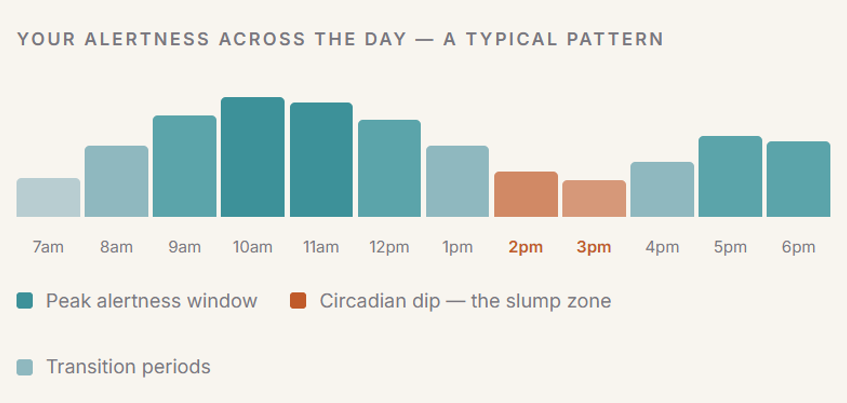
So you cannot eliminate the dip. But what you can control is how deep it goes. And for most remote workers, the dip goes far deeper than it should not because of biology, but because of three specific things that happen or don’t happen between 7am and 9am.
02.The remote work problem - Why remote workers get the slump worse than office workers

If you have ever noticed that you feel the afternoon crash more sharply at home than you used to in an office, you are not imagining it. Remote work removes several environmental cues that without you noticing were helping regulate your circadian rhythm and hydration status every day.
1.No commute means no morning movement or light
The commute was never just transit; it was natural light exposure, physical movement, and a gradual transition into alertness. Remote workers who walk from bed to desk skip all three. Natural light is one of the primary signals that calibrates the SCN and suppresses morning melatonin. Without it, the circadian peak arrives later and lower.
2.No water cooler means no ambient hydration cues
In an office, people walk to kitchens, pour water while chatting, and have regular cues to drink. At home, there are no such prompts. Remote workers are significantlymore likely to go from wake-up to noon without drinking meaningful amounts of water. By the time the slump hits, they are already measurably dehydrated.
3.Blurred boundaries mean worse sleep which deepens the dip
Remote workers are more likely to work in the evenings, check messages before sleep, and struggle to mentally disconnect. Research found that teleworkers frequently work during free time, linked to higher stress and disrupted sleep. Poor sleep dramatically amplifies the afternoon dip.
4.More screen time, less restorative break time
Office workers naturally take micro-breaks in different physical spaces: hallways, meeting rooms, the kitchen. Remote workers tend to stay at the same screen all morning, accumulating cognitive fatigue faster. By early afternoon, decision quality and focus are already significantly lower before the biological dip even lands.
03.The most overlooked cause- The morning dehydration nobody talks about

Of all the factors that determine how badly the afternoon slump hits, dehydration is the most overlooked and the most fixable.
You wake up dehydrated every single morning, without exception. During sleep your body loses approximately one litre of fluid through breathing, perspiration, and ongoing metabolic processes. That is 32oz. Two 16oz servings. The exact volume Ki is built around. You have not drunk anything for seven or eight hours. And the first thing most remote workers do is walk to the kitchen, make coffee, sit down, open the laptop and address none of this.
According to research published in the National Library of Medicine, the effects of mild dehydration on the brain are both specific and measurable. Evidence shows that a body water loss of just 1-2% considered mild dehydration can impair cognitive functions, including attention, concentration, reaction time, and short-term memory.
Importantly, the body’s thirst response is typically triggered within this same 1-2% range, meaning that by the time a person feels thirsty, subtle declines in cognitive performance and mood may already be occurring. Research indicates that as dehydration progresses, the efficiency of cognitive processing decreases, with greater impairments observed at higher levels of fluid loss.
Even modest fluid deficits, which can develop during routine daily activities, have been associated with reduced alertness, increased fatigue, and slower mental performance. As dehydration approaches or exceeds 2% body water loss, these effects become more pronounced, potentially leading to poorer judgment, slower reaction times, and increased likelihood of errors in tasks requiring focus and precision.
The reason dehydration makes the slump worse is direct: your brain is 73% water, and electrolytes are the medium through which neurons fire. When fluid and mineral levels drop, electrical signalling between brain cells degrades producing the exact symptoms of the afternoon slump: slow thinking, poor concentration, and the foggy feeling that no amount of willpower can push through.
The mid-afternoon crash. Mental fog. That familiar 3 PM headache. Most people at work assume it’s due to what they ate or not getting enough sleep. But growing research suggests something far more basic may be at play: mild dehydration.

Remote workers compound this by drinking primarily coffee in the morning which is mildly diuretic and adds to fluid loss rather than water with electrolytes. Recent UK employer research found that 45% of adults believe coffee contributes effectively to hydration, and 28% rely on caffeine to maintain productivity. Both beliefs actively worsen the problem.
04.Why more coffee makes tomorrow's slump worse

When the afternoon fog descends, the instinct is to reach for coffee. It works briefly. But it doesn’t solve the problem. It postpones it, and at a cost.
Caffeine works by blocking adenosine receptors in the brain. Adenosine is the compound your brain naturally produces to signal fatigue it builds up throughout the day, and caffeine stops you feeling it by sitting in the adenosine receptor instead of letting adenosine through. The problem: adenosine doesn’t disappear. When the caffeine block wears off typically 4-6 hours later all the accumulated adenosine floods the receptors at once. That is the crash.
Afternoon coffee delays the crash to the evening. It makes it harder to sleep. Which increases sleep debt. Which makes the next day’s biological dip land harder. Which creates the need for more coffee. The cycle is not a metabolism problem, it is a hydration and timing problem that caffeine is patching over rather than fixing.
The cortisol stacking problem : Morning coffee before hydration adds a second problem. Cortisol your body's natural alertness hormone peaks naturally 30-60 minutes after waking. Adding caffeine on top of an already-peaked cortisol curve significantly amplifies the stress response, increases anxiety, and accelerates the eventual energy decline. Coffee works better and crashes less when it arrives after the cortisol peak has naturally subsided, which happens around 90 minutes after waking.
05.The morning protocol that fixes the afternoon

The slump is not fixed at 2pm. It is either prevented or amplified between 7am and 9am. Here is the morning protocol in order that determines whether your afternoon is functional or foggy.
1.Morning Hydration
Hydrate before anything else. Water is essential, but hydration is more than just drinking water. Your body depends on electrolytes mainly sodium, potassium, and magnesium to manage how water is absorbed, distributed, and retained. These minerals support fluid balance at a cellular level and help maintain normal nerve and muscle function. Without sufficient electrolytes, the body may not use water as efficiently as it could. You can drink plenty of water and still feel less supported than expected, because absorption and retention are mineral-dependent processes.
In simple terms, water is the input electrolytes that help your body actually use it.
2.Natural light and brief movement
Step outside, open a window, or sit near a bright light source. Natural light suppresses morning melatonin and calibrates the SCN, the part of your brain that sets your circadian clock. Even 10-15 minutes makes a measurable difference to when your circadian peak arrives and how high it goes. Pair this with light movement: a short walk replaces what the commute used to do automatically.
3.Avoid immediate stimulation overload
Instead of jumping straight into intense mental work or caffeine, allow your system to stabilize. This helps your natural cortisol rhythm peak and settle properly, which supports more balanced energy later in the day.
4.Introduce stimulation mindfully (optional)
If you use caffeine or other stimulants, this timing tends to be more supportive of smoother energy, as the body is already hydrated and fully awake. Without it, this period still works as a natural transition into focused work without relying on external stimulation.
5. Mid-morning to lunch
Choose meals built around protein, fiber, and healthy fats. This helps maintain steady blood sugar and reduces the sharp rise-and-fall pattern that often leads to mid-day fatigue. Heavy refined-carb meals can amplify energy dips in the afternoon.
If you’re looking for an electrolyte that fits into a structured morning routine,
Ki Electrolytes is built for exactly this window.
After several hours of sleep, the body is typically in a mild fluid and mineral deficit. Starting the day with a meaningful amount of fluid helps restore baseline hydration, and adding electrolytes can further support how efficiently that fluid is absorbed and distributed across the body.
A practical approach is to drink 16oz of Ki Electrolytes on waking, followed by another 16oz about 45 minutes later. Two servings of 16oz equals 32oz, which is approximately one litre. That is not an arbitrary number. It is the precise volume your body lost overnight. The first serving begins replacing the overnight deficit immediately. The second serving, 45 minutes later, completes it as your body continues to stabilize. The spacing mirrors the body’s optimal absorption rate and ensures the fluid reaches cells rather than passing through too quickly.
Ki Electrolytes
What about during the afternoon itself?
If the slump has already hit or if the morning protocol is new and still catching up these interventions work in the moment:
A 10-minute outdoor walk, light, movement, and a change of environment all stimulate alertness without borrowing from tomorrow.
The 10-minute nap. genuinely effective. Beyond 20 minutes, sleep inertia sets in and you wake up groggier. Under 10 minutes, and research confirms it restores alertness without the grogginess.
Reschedule demanding tasks, the slump is real. Using it for admin, routine emails, and low-stakes work rather than fighting it with complex thinking is not a productivity loss. It is working with your biology rather than against it.
Protein or light snack if needed. A small, balanced snack (not high sugar) can help stabilize energy if the slump is partly driven by blood sugar fluctuations after lunch.
Brief reset breaks. 2-3 minutes of standing, stretching, or simply stepping away from the screen can interrupt cognitive fatigue loops and improve task re-entry focus.
The Ki Electrolytes

Ki Electrolytes is designed for one key window that shapes your entire afternoon: the first hour after you wake up. This is the second charge. Sleep is the first charge. It restores roughly 70% of what your brain and body need. But sleep also costs you approximately one litre of fluid overnight. The second charge is the act of replacing it.
It delivers essential natural minerals sourced from the Sea of Japan and ancient European rock formations.No sweeteners. Microplastics removed through advanced 0.5-micron filtration. No flavors. No additives that break your fast or distract your focus.
Just two pure natural mineral salts, microplastic-removed, with no additives, delivered at the exact time your system is most ready to absorb them.
Frequently Asked Questions
1.Why do remote workers experience a worse midday slump than office workers?
Remote workers are more likely to go from bed to desk without natural light, movement, or adequate morning hydration all of which help calibrate the circadian rhythm and set the brain up for peak morning alertness. The absence of a commute removes three environmental cues the brain relied on. Combined with blurred work-life boundaries that disrupt sleep, and the tendency to drink more coffee and less water, the afternoon biological dip lands on a much more depleted baseline than it would in a structured office environment.
2.Why do I feel tired at 2-3 pm even when I slept well?
A predictable secondary drop in alertness between 1pm and 4pm is a normal feature of human biology, part of the circadian rhythm that regulates your sleep-wake cycle. It happens whether you ate lunch, and whether or not you slept well. What determines how badly you feel is dehydration status, morning cortisol, lunch composition, and accumulated cognitive fatigue from the morning. Good sleep reduces severity but doesn’t eliminate the dip.
3.Does dehydration cause the afternoon slump?
Dehydration is not the cause of the midday slump; the circadian rhythm drives that natural dip in energy. However, hydration status can significantly influence how strongly it is felt. Research shows that even mild dehydration of around 1% body weight loss can begin to affect aspects of cognitive performance such as attention and concentration, while higher levels of dehydration (around 2% or more) are more consistently associated with noticeable declines in mental performance, reaction time, and mood.For many people, this mild fluid deficit can develop gradually from overnight fasting and routine morning activity. As a result, the natural circadian energy dip in the middle of the day can feel more pronounced when the brain is already operating under slight hydration stress.
4.What is the best thing to do when the afternoon slump hits?
In order of effectiveness a 10-minute outdoor walk (light and movement both stimulate alertness), a 10-minute nap (genuinely restores alertness without the grogginess of longer sleep), and rescheduling demanding work to earlier or later in the day. Another coffee is the most popular choice but among the least effective it delays the crash without addressing its causes.
5.Does coffee fix the afternoon slump?
Temporarily and at a cost. Caffeine blocks adenosine receptors, which stops you feeling the fatigue signal in the moment. But adenosine accumulates while the block is in place, and when the caffeine wears off it floods the receptors at once. Afternoon coffee typically creates an evening crash, disrupts sleep onset, and worsens the next day’s morning deficit. It is borrowing energy from tomorrow rather than restoring it today.
6.What should I drink in the morning to prevent the afternoon slump?
Water with electrolytes specifically sodium, potassium, and magnesium taken before coffee. Plain water helps but is less effective because without electrolytes, a significant portion passes through rather than reaching cells. The electrolyte transport mechanism (sodium activating the SGLT1 cotransporter in the small intestine) is what pulls water into the bloodstream and ultimately into brain cells. Replacing this overnight, before the day begins, is the most effective single intervention for afternoon cognitive performance.
Start Sharp Tomorrow Morning
Ki Electrolytes. 2 ingredients. 1.5g per serving. No sachets. No microplastics. Built for the morning moment that sets up everything else.