The Product Existed Before the Company Did
Ki was not conceived in a boardroom. It was discovered in two lives – on opposite sides of the world – by two people who had each, independently, hit a wall they could not push through. The transformation happened before the mission was named. The company was built using exactly what it sells.
Zeus
The Second Charge
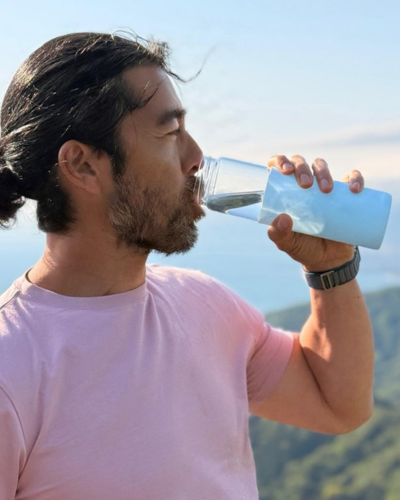
Zeus Kajita was running on coffee and cortisol, 60 pounds overweight, and quietly failing to show up for his young daughter the way she deserved. He woke depleted every morning, reached for coffee before water, and mistook the fog for his personality. The 3pm crashes felt routine. The irritability with his family felt inevitable. He assumed this was just what being a working parent felt like: exhausted, reactive, running on fumes. What he did not realise was that he had been starting every single day at 70% capacity and spending the rest of it trying to compensate for a deficit that began the moment he woke up.
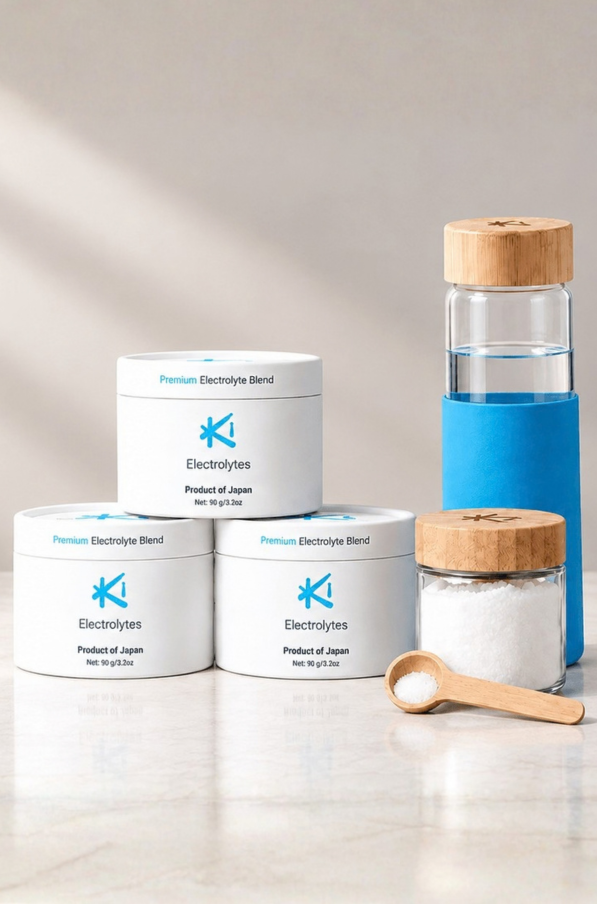
During his frequent trips to Japan, he encountered a different relationship with health. Hydration was treated as foundational. Mineral salts were woven into the fabric of everyday food culture: miso, broths, pickles, sea vegetables. Not as supplements, not as interventions, but as daily inputs that had compounded into a population known for longevity and clarity. He started paying attention to what made water actually work in the brain and body: mineral salts and electrolytes. Small daily rituals. Consistency, not extremes.
The insight that followed was simple: overnight, the body loses fluid and electrolytes. The first hour after waking is when you replace them. He had been skipping that second charge every morning for years and calling it adult life.
The first morning Zeus followed the protocol, his brain cleared within the hour. Not from caffeine. Calm and sharp at the same time. But Ki did not change his life. It gave him the energy to want to change it.
When you are living at 70%, you do not show up fully anywhere. Not in your work, not in your relationships, not with the people who need you most. You give everyone the depleted version and convince yourself that is the best you have.
Over time, Zeus lost 60 pounds. The anxiety reduced. The heaviness lifted, emotionally and physically. The creative work returned. He felt more like himself than he had in years. Not in one dramatic day, but through compounding. Through the Japanese principle of kaizen: small daily inputs that become a different life over time.
That shift led him to Noa. And Noa is the reason Ki became a company. Because without her clarity, her experience, and the proof she became on the rituals themselves, Ki would have remained a personal discovery. She is why it became something the world can finally access.
“Sleep gets you to 70%. Hydration closes the gap. I had been skipping the second charge for so long, I had forgotten what 100% felt like.” — Zeus Kajita, Co-founder

Noa
The Ritual That Changed Everything
Noa Fernando’s version of hitting the wall looked like resilience from the outside. A Dutch-Sri Lankan life built across luxury hospitality, real estate, exports, and manufacturing in Sri Lanka. Then came a series of severe health scares. A long stretch of treatment. A return and rebuilding. A factory fire. The Easter bombing attacks in Sri Lanka. COVID. And then, just after COVID, the political and economic crisis. Wave after wave, each one demanding more than she thought she had. She kept performing. Inside, she had quietly stopped taking care of herself. PCOS and chronic anxiety compounded everything — the brain fog and the exhaustion normalized so thoroughly they no longer registered as symptoms. She met Zeus in Japan, completely burned out. He gave her the science and stood by her through a transition that was almost disarmingly simple: basic daily hydration steps, done the same way every morning.
That ritual became a form of self-respect — a small, repeatable act of love that changed her momentum. Instead of constantly performing in her own life, she started showing up for herself. And once she did, everything else followed like dominos: she began walking more, exercising, eating better, taking care of herself in ways that had quietly fallen away. The energy came back first — and with it, the desire to live differently. Then life delivered the final undeniable lesson. She was hospitalised for two weeks with sepsis — then a year later, dengue haemorrhagic fever, its most dangerous form. Platelet counts dropping by the hour. Ten days watching the numbers fall. And throughout both hospitalisations, administered continuously without pause, twenty-four hours a day: saline. A drip of mineral salt water running directly into her veins.
This is the founding protocol of emergency medicine. Before a diagnosis is confirmed, before a single drug is administered, before almost anything else — the IV goes in and fluids run. Because the human body cannot respond to any intervention until the fluid and electrolyte substrate it runs on is restored. Noa lay in that hospital bed thinking about everything Zeus had told her — and realised that medicine at its most urgent had known this all along. Ki is that principle applied to the one depleted state that repeats every single morning without exception.
“When the body is at its weakest, what doctors reach for first is not a complex drug. It is mineral salt water.” — Noa Fernando, Co-Founder
Ki Created Ki
There is something worth saying about how Ki was actually built. Building a company at this level of complexity demands a specific cognitive state: the ability
to absorb and synthesise months of deep research across hydration science, electrolyte physiology, microplastics, Japanese manufacturing, and brand
strategy; the sustained focus to hold all of it simultaneously and turn it into product decisions.
The formula, the supply chain, the brand strategy, the operational systems – all of it was conceived and built by two people completing the second charge every
morning before the work began.
“We couldn’t have built Ki before Ki. The thinking that conceived it, the focus that developed it, the energy that drove it every day – all of it came from the protocol.”