
Zero sugar. No artificial flavors. Brain boost. The labels look great. But there’s one contamination problem running through nearly every product in the category and nobody is talking about it.

Pick up almost any electrolyte product and you’ll see the same words. Zero sugar. No artificial sweeteners. No fillers. These things matter. And most of the major brands have genuinely removed the obvious junk: the dyes, the sweeteners, the synthetic caffeine. That’s real progress.
But here’s what none of those labels mention: the salt inside almost every one of those products contains microplastics. And most of the sachets those products come in add more. Every single day, people are buying “clean” electrolytes and unknowingly delivering tiny plastic particles directly into their bodies in a product specifically designed to optimize absorption.
This is not a fringe concern. In 2025, researchers found microplastics inside the human brain. The problem is real, the exposure is daily, and the electrolyte industry has been mostly silent about it.
Microplastics are tiny pieces of plastic smaller than 5 millimeters, many of them so small you can’t see them without a microscope. They come from two places. Some are made small on purpose, like the microbeads once used in face washes and toothpaste. Most come from larger plastic items, bottles, bags, packaging, synthetic clothing that break down over time into smaller and smaller fragments.
The smallest of these fragments called nanoplastics are smaller than a single human cell. They’re small enough to pass through your gut wall, enter your bloodstream, and travel to your organs. And in 2025, researchers at the University of New Mexico confirmed what many scientists feared: they found microplastics inside human brain tissue.
Rise in brain microplastic levels between 2016 and 2024
Nature Medicine, 2025
Of commercial salts test positive for microplastic contamination
Scientific Reports
Microplastic particles per kilogram found in Himalayan pink salt.
Nature Medicine, 2025
You might be thinking, microplastics are everywhere. They’re in the air, in tap water, in food. So why does it matter if they’re in my electrolytes too?
Here’s why it matters: it’s about the conditions of exposure.
Most microplastic exposure happens passively a little in the air you breathe, a little in the water you drink. Your body encounters these in small, scattered amounts throughout the day, mixed with everything else you consume.
Electrolytes are different. You take them deliberately. Dissolved in water. On an empty stomach. First thing in the morning when your digestive system has been resting for hours and absorption is at its highest efficiency. You’re not passively encountering microplastics through background exposure. You’re actively delivering them into your system under optimal absorption conditions.
And you’re doing this every single day.
At two servings a day which is the standard protocol for most electrolyte brands, you take your electrolytes 730 times a year. If your product contains microplastics, that's 730 direct, intentional deliveries of plastic particles into your gut under high-absorption conditions. This is not background exposure. It is a daily, deliberate, optimized delivery.
The long-term effects of microplastic accumulation are still being studied. Researchers are careful not to overstate what we know. But what the 2025 Nature Medicine study confirmed is that microplastics accumulate in human kidney, liver, and brain tissue, and brain tissues showed higher concentrations of microplastics than liver or kidney samples. The levels of microplastics found in the brains of people who died in 2024 were about 50% higher than the levels found in the brains of people who died in 2016.
The trend is clearly moving in the wrong direction. And your daily supplements are a part of that equation whether or not the label acknowledges it.

Most people, if they think about this at all, assume microplastic contamination in supplements comes from packaging. That’s one source. But there are actually three separate ways microplastics enter your electrolyte product and most brands have not addressed any of them.
1.The salt itself is contaminated
Salt is the primary ingredient in almost every electrolyte product. And research covering studies from 2015 to 2025 consistently finds microplastics in commercial salts worldwide. Sea salt sources from ocean water where plastic pollution is highest. Rock salt from mining operations with plastic equipment contamination. Even Himalayan pink salt, the option marketed as the cleanest, tested at 174 particles per kilogram in a widely cited Scientific Reports study, the highest of any salt type tested. The contamination is in the raw material before the product is ever made.
2.The packaging releases plastic into the drink
Single-use electrolyte sachets, the standard format for most major brands, have a thin polymer film lining on the inside. When you mix the powder with liquid, that lining is in direct contact with the drink. Research on food-grade plastic packaging confirms that polymer linings leach microplastic particles into the contents, particularly when mixed with liquid. The sachet that was supposed to deliver your “clean” electrolyte is actively contaminating it.
3.Opening the sachet adds plastic directly to the drink
This one surprises most people. When you tear open a sachet, the mechanical shearing of the multilayer plastic film releases fragments of plastic directly into the air and into the product itself. These fragments fall into the drink at the exact moment you open it. It’s a contamination event that happens every single time, with every single serving. It cannot be avoided with a single-use sachet format, regardless of how clean the ingredients inside are.
At two servings per day, a sachet-based electrolyte brand generates 730 single-use plastic sachets per customer per year. These are multilayer plastic films not recyclable in most municipal systems. They go to the landfill. They fragment into microplastics. They contaminate water sources. And eventually, they cycle back into the environment that produces the salt used in next year’s product. The format creates the contamination it claims to have left behind.
To be fair: most clean electrolyte brands have done good work on removing things that shouldn’t be in a supplement. No sugar is real progress. No artificial sweeteners matter. No synthetic dyes, no fillers, no cheap additives these are genuine improvements over the sports drink era.
But there’s a significant gap between what these brands promote and what they actually address. Here’s how the category stacks up against the microplastic problem:
The pattern is clear. The category has made real progress on ingredient quality but has a blind spot either by choice or by oversight on the one contamination source that is present in almost every product, in every format, regardless of how premium the brand.
Let’s break this down simply, because it’s worth understanding what filtration at this level actually does.
A micron is one millionth of a meter. To put that in perspective a human hair is about 70 microns wide. A red blood cell is about 8 microns. Microplastic particles that are small enough to pass through the lining of the gut and enter the bloodstream are typically smaller than 5 microns. The ones that can pass the blood-brain barrier which is what the 2025 Nature Medicine study found are even smaller.
Human hair, visible to the naked eye
Threshold for gut wall penetration -microplastics this size can enter the bloodstream
Ki’s filtration level – removes particles at 0.5 microns and larger, capturing microplastics well below the gut-penetration threshold
Nanoplastics below current filtration technology; present in all products to some degree
Standard commercial salt processing does not filter for microplastics. It filters for the things that affect taste and purity by traditional measures bacteria, large sediment, color. Microplastic particles are not on the checklist because they don’t affect how the product looks, tastes, or functions. They’re invisible and tasteless. They just accumulate.
A 0.5-micron filtration process means that during the purification of the mineral source, any particle 0.5 microns or larger is physically removed. This captures the vast majority of microplastic particles that are at or above the size threshold for biological significance, the ones that can enter cells, cross into the bloodstream, and
0.5 microns is not arbitrary. It represents a meaningful threshold: below the size at which particles are most likely to penetrate biological membranes and enter systemic circulation. Filtering to this level from the mineral source before the product is ever formulated removes the contamination at the point where it’s most practical and most impactful to address it.
No filtration can remove everything. Nanoplastics particles smaller than 0.1 microns are present in most water sources and environments, and current technology cannot fully remove them at scale. But addressing the particles in the range where the highest biological risk lies, from the primary ingredient, is a meaningful and measurable step that almost no other brand in the category is taking.
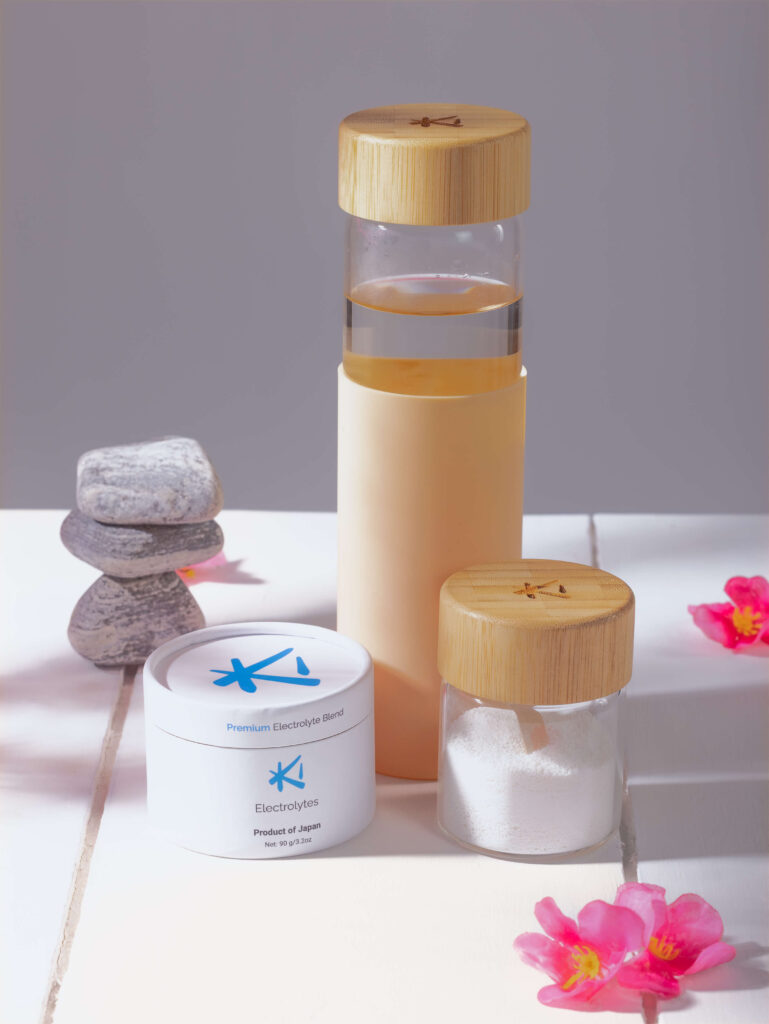
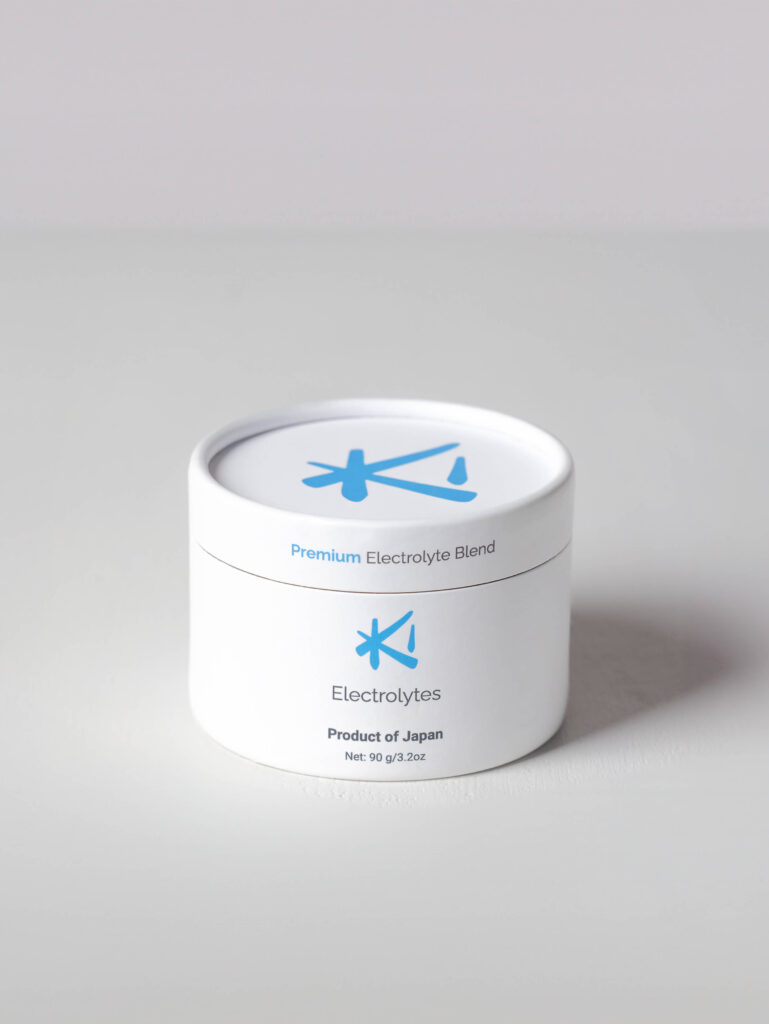
Ki was built by two founders Zeus and Noa who discovered the microplastic problem while researching clean hydration for themselves. Ki Electrolytes uses two whole natural mineral salts harvested from the Sea of Japan and ancient European rock formations processed through a proprietary 0.5-micron microplastic removal system. No sachets. No polymer linings. No tear contamination. A refillable glass jar with bamboo components that you use, refill, and keep.
The Salt
0.5-micron microplastic filtration applied directly to the mineral source during processing in Japan.
The Format
Eco-friendly paper cylinder with a metal lid.
The Formula
Sodium 861mg · Potassium 159mg · Magnesium 53mg · Calcium (6mg) Zero sugar · Zero sweeteners · Zero artificial anything
The Packaging
97% less packaging waste than a sachet-equivalent product · Compostable refill pouches available
Most do through three sources most consumers don’t know about. First, the salt used in almost all electrolyte products: research from 2015 to 2025 consistently shows microplastic contamination in commercial salts. Second, single-use sachet linings that leach plastic particles when mixed with liquid. Third, the physical act of tearing a sachet open releases plastic fragments into the drink. Very few brands address any of these, and Ki Electrolytes is the only major brand to address all three simultaneously.
No and this surprises most people. Despite its clean, natural image, Himalayan pink salt consistently tests among the highest for microplastic contamination in independent studies. A widely cited 2019 Scientific Reports study found Himalayan pink salt contained 174 microplastic particles per kilogram, the highest of any salt type tested across 39 brands in 21 countries. The natural origin of the salt does not protect it from plastic contamination in the environment where it’s sourced.
A 0.5-micron filtration process removes any particle 0.5 microns (half a millionth of a meter) or larger. This captures the vast majority of microplastic particles in the size range most associated with biological significance, the range at which particles can penetrate gut tissue, enter the bloodstream, and accumulate in organs. It does not remove nanoplastics below 0.1 microns, which are present in most water sources and cannot currently be removed at scale. But it addresses the primary contamination source in a meaningful, measurable way.
The conditions under which you take a supplement affect how much of it including any contaminants your body absorbs. On an empty stomach, the digestive system has nothing else to process. Absorption efficiency is at its peak. This is exactly why morning electrolyte use is effective and exactly why microplastic contamination in morning electrolytes is a more significant exposure route than encountering the same particles in a meal or passively through the environment. You’re optimizing delivery conditions for both the minerals and anything else that comes with them.
Microplastics don’t affect taste, color, or shelf life. They don’t trigger regulatory action or product recalls. They’re invisible and tasteless so there’s no consumer complaint driving change. The marketing language of “clean,” “zero sugar,” and “no artificial ingredients” satisfies most buyers without requiring the more expensive and technically challenging work of addressing plastic contamination in the mineral source and format. It’s a gap that exists because the category’s clean credentials have never been tested against this specific question.