
You're Not Just Getting Older. Dehydration May Be Making You Age Faster.
A 30-year NIH study of 11,255 adults found that chronic dehydration measurably accelerates biological aging, increases disease risk, and shortens lifespan. Here’s what’s actually happening inside your body and the daily habit that can slow it down.

When most people think about aging faster, they think about sun damage, stress, smoking, or poor diet. Those are real. But there’s one factor that most people overlook entirely and it’s happening to the majority of adults every single day before they’ve even left the house.
Chronic dehydration. Not dramatic dehydration, no dizzy spells or hospital visits. The quiet, daily kind. The kind where you wake up without drinking anything, make coffee, skip water through the morning, and repeat this across weeks, months, and years.
Research is now showing that this pattern has a measurable biological cost, one that accelerates aging at the cellular level in ways that compound over decades. And the fix, when you understand what’s actually happening, turns out to be far simpler than most anti-aging advice ever acknowledges.
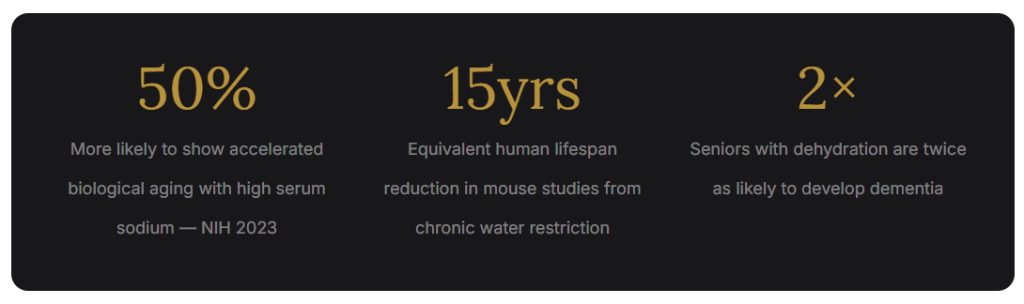
The bottom line up front : A landmark 2023 NIH study found that adults with consistently elevated serum sodium, the most reliable marker of chronic low fluid intake, were 50% more likely to show accelerated biological aging, develop chronic disease earlier, and die at a younger age. The researchers concluded: "Proper hydration may slow down aging and prolong a disease-free life.
01.The NIH study that changed how we understand hydration and aging
In January 2023, researchers at the National Heart, Lung, and Blood Institute (NHLBI) at the NIH published what has since become one of the most cited studies on hydration and longevity. Led by Dr. Natalia Dmitrieva and published in eBioMedicine, it was the result of tracking 11,255 adults over up to 30 years.
What they measured was serum sodium, the concentration of sodium in the blood. This is one of the most well-established, reliable markers of long-term hydration status. When you consistently drink too little fluid, your kidneys concentrate sodium in the blood to preserve fluid volume. Over time, elevated serum sodium becomes a fingerprint of chronic dehydration.
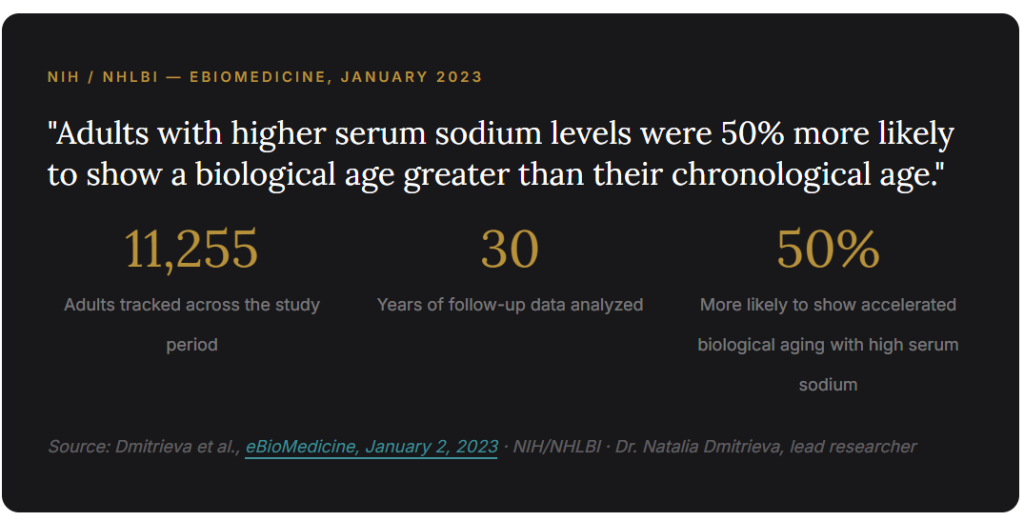
The findings were specific. People whose serum sodium exceeded 144 mmol/L were significantly more likely to show a biological age above their chronological age measured through validated biomarkers. They also developed chronic diseases earlier and showed higher rates of premature mortality.
Importantly, the researchers found that the sweet spot for serum sodium, the range associated with the slowest biological aging, was between 137 and 142 mmol/L. Reduced fluid intake is the most common reason for elevated serum sodium. In other words, the simplest explanation for most cases of elevated serum sodium and the most actionable is not drinking enough fluid consistently over time.
What "biological age" means : Chronological age is how many years you've been alive. Biological age is how old your cells, tissues, and organs actually are measured through biomarkers like blood chemistry, organ function, and inflammatory markers. You can be 45 chronologically and have the biological age of a 55-year-old. The NIH study found that chronic dehydration is one of the measurable contributors to this gap.
02.What dehydration actually does inside your body

Understanding why dehydration ages requires looking at what is happening at the cellular level, not just the organ level. The effects are specific, measurable, and in many cases, largely preventable.
1. It triggers chronic low-grade inflammation
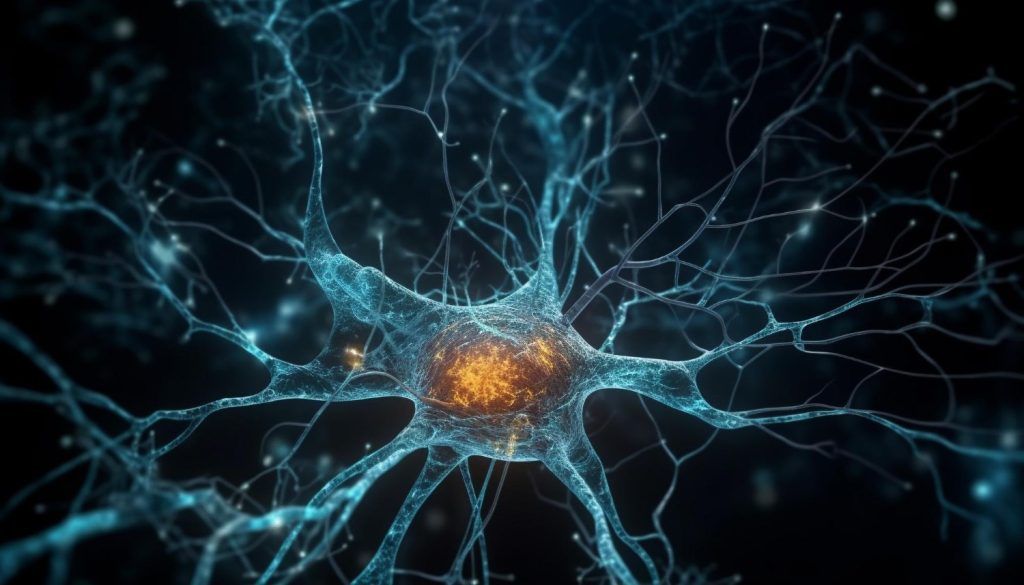
When cells are chronically dehydrated, they produce more free radicals and pro-inflammatory compounds. These studies show increased serum sodium can lead to the kinds of pro-inflammatory activity and DNA damage that has been linked with accelerated aging. Researchers describe this state as inflammaging, a term coined to describe the chronic, low-grade inflammation that quietly drives age-related disease without producing obvious symptoms. It doesn’t hurt. It just compounds.
2. It breaks down collagen faster than normal aging
Dehydrated cells produce more free radicals and inflammatory compounds that directly attack existing collagen fibers, breaking them down faster than normal aging would. Collagen is the structural protein that keeps skin firm, joints cushioned, and connective tissue intact. When dehydration accelerates its breakdown while simultaneously slowing new collagen production, the structural aging of the body, not just the surface of the skin speeds up.
3. It impairs cellular waste removal
Cells produce metabolic waste as a byproduct of normal function. Water is the primary medium through which this waste is removed. When fluid at the cellular level is insufficient, waste accumulates inside and around cells accelerating the damage and dysfunction that defines biological aging. Physiological dehydration, a hallmark of aging, intensifies inflammaging, accelerating tissue degeneration.
4. It puts the cardiovascular system under chronic stress
When blood volume is reduced due to dehydration, the heart has to work harder to maintain circulation and oxygen delivery. Even mild dehydration increases stress on the cardiovascular system. Over years, this accelerates wear-and-tear on the arteries, leading to early aging. This isn’t dramatic cardiovascular disease, it’s low-level wear that accumulates over years and decades into measurable biological age acceleration.
03.The hidden effects most people never connect to dehydration

The outward signs of aging wrinkles, energy loss, joint discomfort, slower thinking are almost always attributed to the passage of time. But research increasingly shows that chronic dehydration is a significant, often overlooked driver of these exact symptoms. Here is what is actually happening beneath the surface.
Skin - Wrinkles Arrive Earlier
Chronically dehydrated skin loses elasticity as collagen breaks down and cellular turnover slows. Dead skin cells accumulate. New cell production decreases. The result looks like accelerated aging because it is.
Joints -Cartilage Breaks Down Faster
Cartilage is almost entirely collagen and water. When dehydration reduces its fluid content and accelerates collagen degradation, joint pain and stiffness appear earlier than they biologically should.
Brain-Cognitive Decline Accelerates
The brain is 73% water. Seniors with dehydration are twice as likely to develop dementia. Hydration regulates neurotransmitters like serotonin and dopamine. Chronic dehydration accelerates the neurological aging that contributes to memory loss and cognitive decline.
Kidneys-Organ Function Degrades
The brain is 73% water. Seniors with dehydration are twice as likely to develop dementia. Hydration regulates neurotransmitters like serotonin and dopamine. Chronic dehydration accelerates the neurological aging that contributes to memory loss and cognitive decline.
Energy & Metabolism - Mitochondrial Efficiency Drops
Magnesium, an electrolyte depleted by chronic dehydration, is required for ATP synthesis, the fundamental energy-generation process in every cell. When magnesium levels fall consistently low, cellular energy production becomes less efficient. The fatigue that appears to be “just getting older” is, in many cases, a downstream effect of years of mild mineral depletion.
04. The aging loop how dehydration compounds over time
The most troubling aspect of dehydration-driven aging is not any single effect. It’s the loop, the self-reinforcing cycle that makes chronic dehydration increasingly hard to escape as you get older.
Stage 1 - Daily deficit - Chronic mild dehydration begins
Most people wake up dehydrated and don’t fully address it. Fluid intake is consistently below what the body needs. No alarm bells, just a quiet deficit that runs every day.
Stage 2 - Cellular damage - Inflammation and collagen loss begin
Dehydrated cells produce more free radicals and inflammatory signals. Collagen breaks down faster than it’s replaced. DNA damage accumulates. This is the stage where biological age starts diverging from chronological age.
Stage 3 -The thirst problem-The body's hydration signal degrades with age
This is the cruel part: as you age, the thirst mechanism becomes less sensitive. You can be significantly dehydrated without feeling thirsty. The body stops reliably asking for what it needs which means intentional hydration habits become increasingly critical, not optional.
Stage 4 - Acceleration - Dehydration deepens as aging advances
Aging itself reduces the body’s water content. Combined with the degraded thirst signal and a lifetime of mild fluid deficit, chronic dehydration becomes progressively more severe accelerating the biological aging it helped create. The loop closes and tightens.
"Proper hydration may slow down aging and prolong a disease-free life."
Dr. Natalia Dmitrieva, lead researcher, NIH/NHLBI eBioMedicine, 2023
05.Why the morning is when it matters most
Understanding the aging loop makes the morning habit clear. Every night, you lose approximately one liter of fluid through breathing, perspiration, and metabolic processes that don’t pause for sleep. You wake up in mild dehydration every single morning, without exception. What you do in the first hour determines whether that deficit is addressed or compounded into the day, the week, and ultimately the decades.
The morning is also when the body is most receptive to hydration. No food competing for absorption. No compounds in the digestive tract reducing uptake efficiency. The SGLT1 cotransporter, the intestinal mechanism that pulls water into the bloodstream and cells is unoccupied. It’s the highest-efficiency hydration window of the day, and it’s the window most people fill with coffee.
Why plain water isn’t fully sufficient
This is the most important nuance in the hydration-aging conversation. Drinking water is necessary but it isn’t sufficient on its own. Without electrolytes, water doesn’t reach cells effectively. The sodium-driven transport mechanism requires adequate mineral presence to pull water from the gut into the bloodstream and from the bloodstream into cells.
Chronic dehydration doesn’t just mean insufficient water. It means insufficient water reaching cells. That’s a transport problem, not just a volume problem. And it’s why electrolytes are part of the anti-aging conversation in ways that most people haven’t been told.
What consistent morning hydration actually changes
Every morning you restore fluid and electrolyte balance before the day begins, you are interrupting the dehydration loop at its earliest point. Over weeks and months, this maintains serum sodium in the range associated with the slowest biological aging. Over years and decades, the research suggests this is one of the most consistent, accessible, and evidence-backed longevity habits available to anyone.
The 30-year takeaway
The NIH study didn’t measure a dramatic intervention. It tracked what people did every day for 30 years. The difference between the group that aged fastest and the group that aged slowest came down to fluid intake consistent, daily, unremarkable hydration. Not supplements, not treatments. Just water and the minerals that make it work. Starting every morning with the right intention is not a small habit. Over three decades, it is one of the most significant investments you can make in your biological age.
The morning habit that addresses aging at its source.
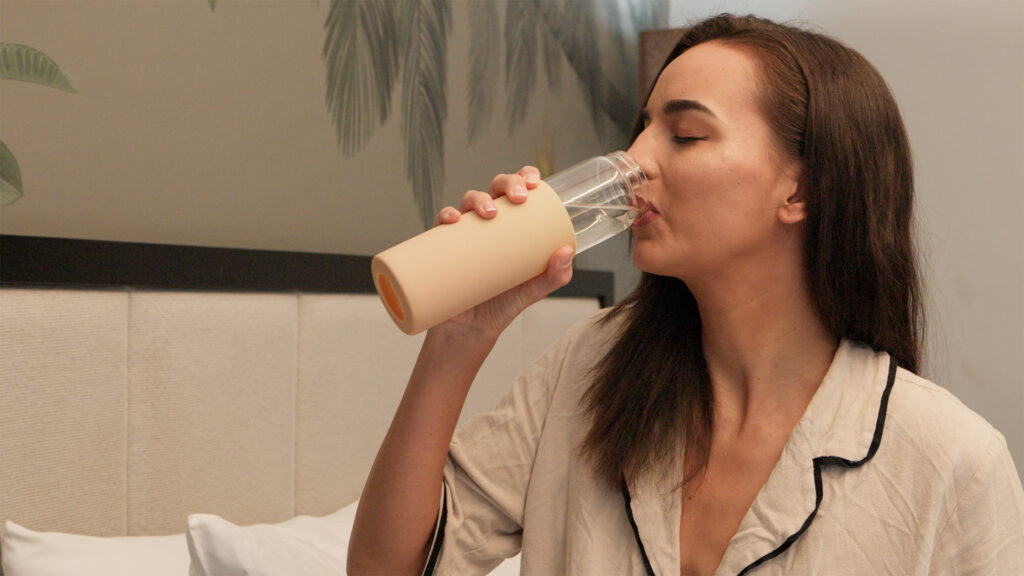
Ki was built around the body’s most important biological window: the first hour after waking.
After an entire night without water, the body enters the morning depleted, dehydrated, and under-restored. Cellular repair slows. Cognitive sharpness declines. Stress signals rise. Yet this same window is also when the body is most receptive to restoration.
This is where Ki begins.
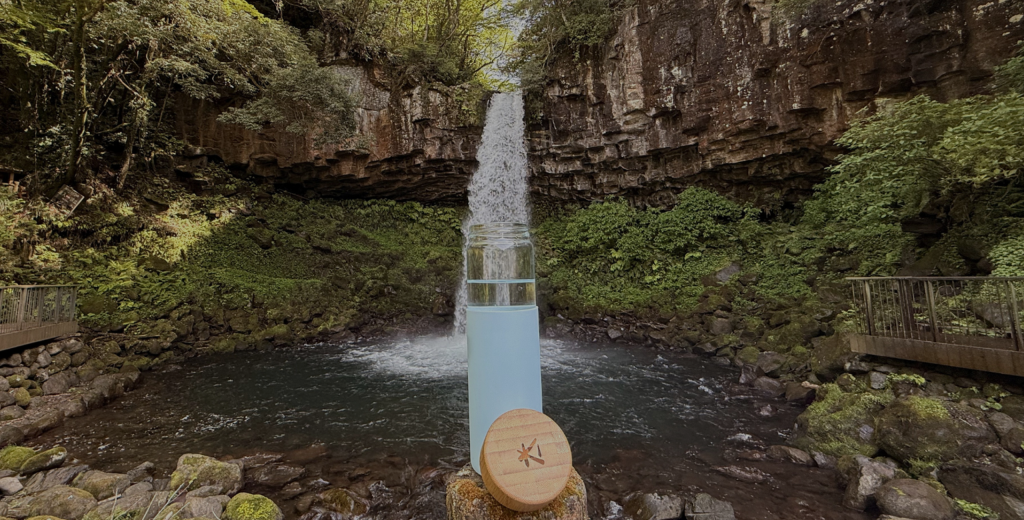
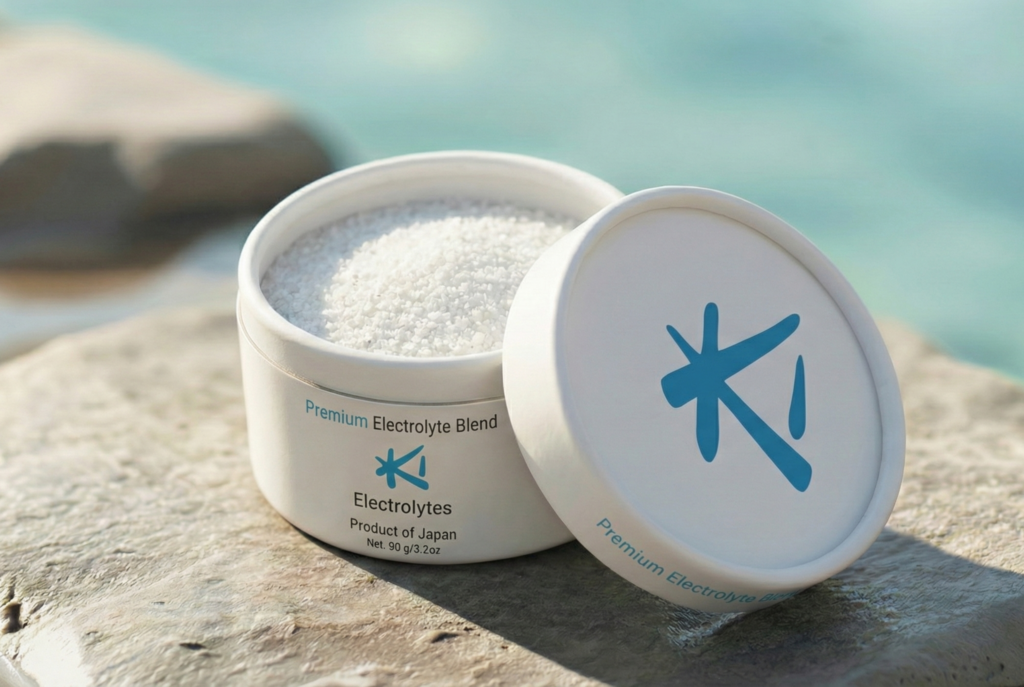
Made from two whole natural mineral salts sourced from the Sea of Japan and ancient European rock formations, Ki delivers hydration in its cleanest and most elemental form. Every batch is processed through an advanced 0.5-micron microplastic removal system to ensure purity without compromise. No sugar. No flavors. No synthetic additives. Nothing engineered to overstimulate. Nothing artificial to disguise what your body truly needs.
Only the minerals your cells were designed to recognize and utilize.
The ritual is intentionally simple: hydrate deeply before caffeine, before screens, before the demands of the day begin. Because the way the body performs, repairs, and ultimately ages is heavily influenced by what happens in these first moments each morning.
Step 1
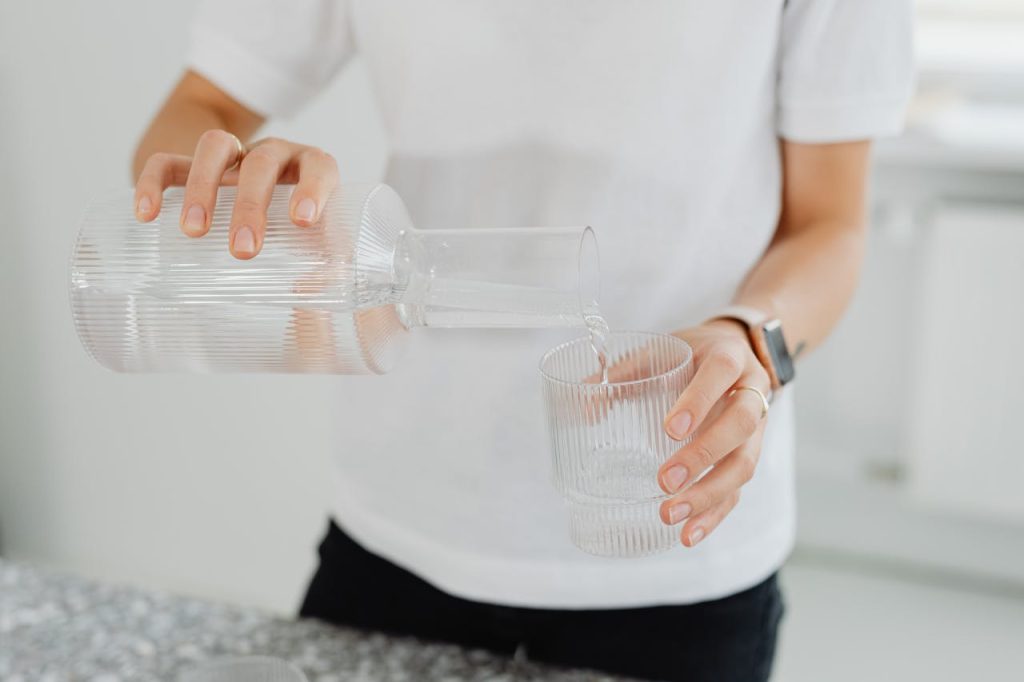
16oz of water with Ki within the first 15 minutes of waking. On an empty stomach. Before coffee. Before supplements
Step 2
A second 16oz serving approximately 45 minutes later.
32oz within the first hour. Two minutes of preparation. The overnight deficit was restored before the first demand of the day.
Ki is not designed to create artificial energy spikes. It is designed to restore the internal conditions that sustained energy, mental clarity, recovery, and longevity depend on.
Ki Electrolytes
Frequently Asked Questions
Does dehydration actually make you age faster?
The evidence strongly supports this. A landmark 2023 study from the NIH’s National Heart, Lung, and Blood Institute followed 11,255 adults for up to 30 years and found that people with consistently elevated serum sodium the primary marker of chronic low fluid intake were 50% more likely to show a biological age greater than their chronological age. They also developed chronic disease earlier and had higher rates of premature death. While the study is observational and does not prove causation, the size, duration, and consistency of the findings are significant.
How does dehydration cause inflammation and speed up aging?
Chronic dehydration leads cells to produce more free radicals and pro-inflammatory compounds, triggering a state called inflammaging chronic low-grade inflammation that drives cellular damage, collagen degradation, and the accumulation of waste products that the body can no longer remove efficiently. Elevated serum sodium also directly promotes pro-inflammatory activity and DNA damage. Over years, this produces measurable differences in biological age compared to well-hydrated peers.
What is the connection between serum sodium and biological aging?
Serum sodium is a well-established, long-term marker of hydration status. When fluid intake is chronically insufficient, kidneys raise blood sodium concentration to preserve fluid volume. The NIH eBioMedicine study found that serum sodium above 144 mmol/L was associated with 50% higher odds of accelerated biological aging. The target range associated with slowest aging was 137–142 mmol/L. Reduced fluid intake is identified as the most common cause of elevated serum sodium.
What does dehydration do to collagen and skin?
Dehydrated cells produce inflammatory compounds that directly attack collagen fibers, breaking them down faster than the natural aging process would. At the same time, cellular turnover slows meaning dead skin cells accumulate while new cell production decreases. The skin loses its ability to maintain elasticity and firmness. These effects are often attributed entirely to chronological age but are significantly accelerated by chronic dehydration. Keeping cells properly hydrated supports the conditions for normal collagen synthesis and maintenance.
Why isn't plain water enough to prevent dehydration and aging?
Water volume is only part of the equation. Hydration at the cellular level depends on electrolytes, particularly sodium, activating the intestinal transport mechanism (SGLT1 cotransporter) that pulls water from the gut into the bloodstream and ultimately into cells. Without adequate electrolytes, a significant portion of the water you drink passes through rather than reaching the tissues that need it. This is especially relevant in the morning, when the body is most depleted and the transport mechanism is most available to be used efficiently.
Can electrolytes help slow the aging process?
Electrolytes address one of the most significant and preventable accelerators of biological aging. By enabling cellular hydration rather than just fluid intake, they help maintain the fluid balance that protects against chronic inflammation, collagen degradation, oxidative stress, and cardiovascular strain. Magnesium specifically plays a role in ATP production, DNA repair mechanisms, and cortisol regulation all of which are directly relevant to biological aging. Consistent morning hydration with electrolytes is one of the most evidence-backed, accessible longevity habits in the current research.
Start Sharp Tomorrow Morning
Ki Electrolytes. 2 ingredients. 1.5g per serving. No sachets. No microplastics. Built for the morning moment that sets up everything else.